
Making space for threatened species
Dr James Gilroy (Chief Scientist) and Bright Opoku (Ghana Biodiversity Officer) report on some exciting recent findings from our baseline biodiversity monitoring work, and the prospects for biodiversity recovery through large-scale habitat restoration.
Among the most exciting things about working in restoration is the thrill of seeing wildlife returning to deforested areas. While the forest structure can re-grow quickly, the recovery of animal populations can take more time – particularly if local populations have already been depleted at the wider landscape scale. Excitingly, however, our baseline survey work is uncovering a surprising diversity of forest species persisting in the degraded landscapes where we operate, even before our restoration efforts take shape. Recent baseline surveys in Ghana have uncovered a wide array of interesting species, including two that are classed as Critically Endangered by IUCN – placing them among the most threatened species on earth (more on these below). These surprising discoveries underscore the tremendous wealth of biodiversity that the Upper Guinean Forest zone supports, and the benefits that will come from boosting the availability of habitat for these highly imperilled populations.
Establishing the Baseline
At Rainforest Builder, our aim is to restore forests that are as similar as possible to the primary forests that once covered this part of West Africa, which means bringing back the full complement of regional biodiversity alongside the trees. Monitoring our progress is an essential component of this work, just as it is for carbon. However, monitoring biodiversity is not particularly straightforward. Unlike carbon, where quantities can be measured in easily-interpreted units of tonnes per hectare, biodiversity is a multi-faceted entity that is more difficult to boil down into simple numbers. Most of the species we are interested in monitoring are also extremely difficult to detect - many are shy, some are nocturnal or highly cryptic, and some inhabit canopy environments that are difficult to access. The sheer diversity of tropical environments also presents a challenge in itself – correctly identifying species amongst the thousands of candidates in the region requires a high level of expertise, and for some species groups there is even a lack of good guidebooks.
Above: a Maxwell’s Duiker captured by one of our biodiversity monitoring camera traps – this species inhabits moist lowland forests across the Upper Guinean region, and despite being classed as Least Concern by the IUCN it has a declining population trend due to increasing threats from hunting and habitat loss.
Generating robust monitoring data in these environments requires a toolbox of complementary approaches. We have developed a monitoring framework that uses a range of different approaches to collect biodiversity data, each providing a different window on the status of wildlife within our restoration areas. Some are traditional, others more cutting-edge, but each plays its own part in telling the unfolding story of wildlife recovery in our restoration sites. Accurate measurement of long-term change depends on having a good understanding of the biodiversity landscape at the very beginning, which is why our pre-project baseline surveys are so important.
Eyes and ears in the forest
The core pillar of our biodiversity monitoring framework is a rigorous on-ground census led by experienced ecologists. In a hyper-diverse tropical forest, there is still no substitute for the trained ears of an expert ornithologist to distinguish between the calls of many hundreds of species of birds, or to identify tracks and signs that can provide clues to the presence of cryptic mammals. Developing this local expertise requires many years in the field, and we are fortunate to have several expert surveyors in our team who can accurately name every bird, every mammal and every reptile they encounter, even from the briefest of views.
To make the data useful for long-term monitoring, it is essential that our surveys are highly systematic. We therefore follow repeatable transect routes and carefully record the time and distance of each species detection from fixed long-term point count locations. Because even experts seldom detect every animal that is present in the survey area during a single visit, we repeat each survey route multiple times across consecutive days. This builds a rich dataset that allows us to estimate ‘true’ abundance of species, accounting for the fact that we’re unlikely to ever count every individual that is present. Over time, these datasets will flow into a set of standardised indicators that form a highly sensitive barometer of ecosystem health and diversity.
Above: Lowe’s Monkey is a lowland forest species that occupies a wide range of habitats, including secondary forests and can occasionally extend into human-modified habitats. Globally it has declined significantly due to habitat loss and unregulated hunting, leading to it being listed as Vulnerable on the IUCN Red List.
Alongside our timed transect and point count surveys, we also deploy camera traps that help detect shy and crepuscular/nocturnal species that are difficult to survey directly. So far, our surveys have detected more than 200 species including 27 mammals and 150 birds. There’s a special thrill in checking the memory card of a recovered camera trap after a long field deployment – you never know quite what you’re going to have snapped, and it can be a fun challenge to piece together the identities of ‘near-miss’ detections where only part of an animal has been captured in the frame!
The sound of recovery
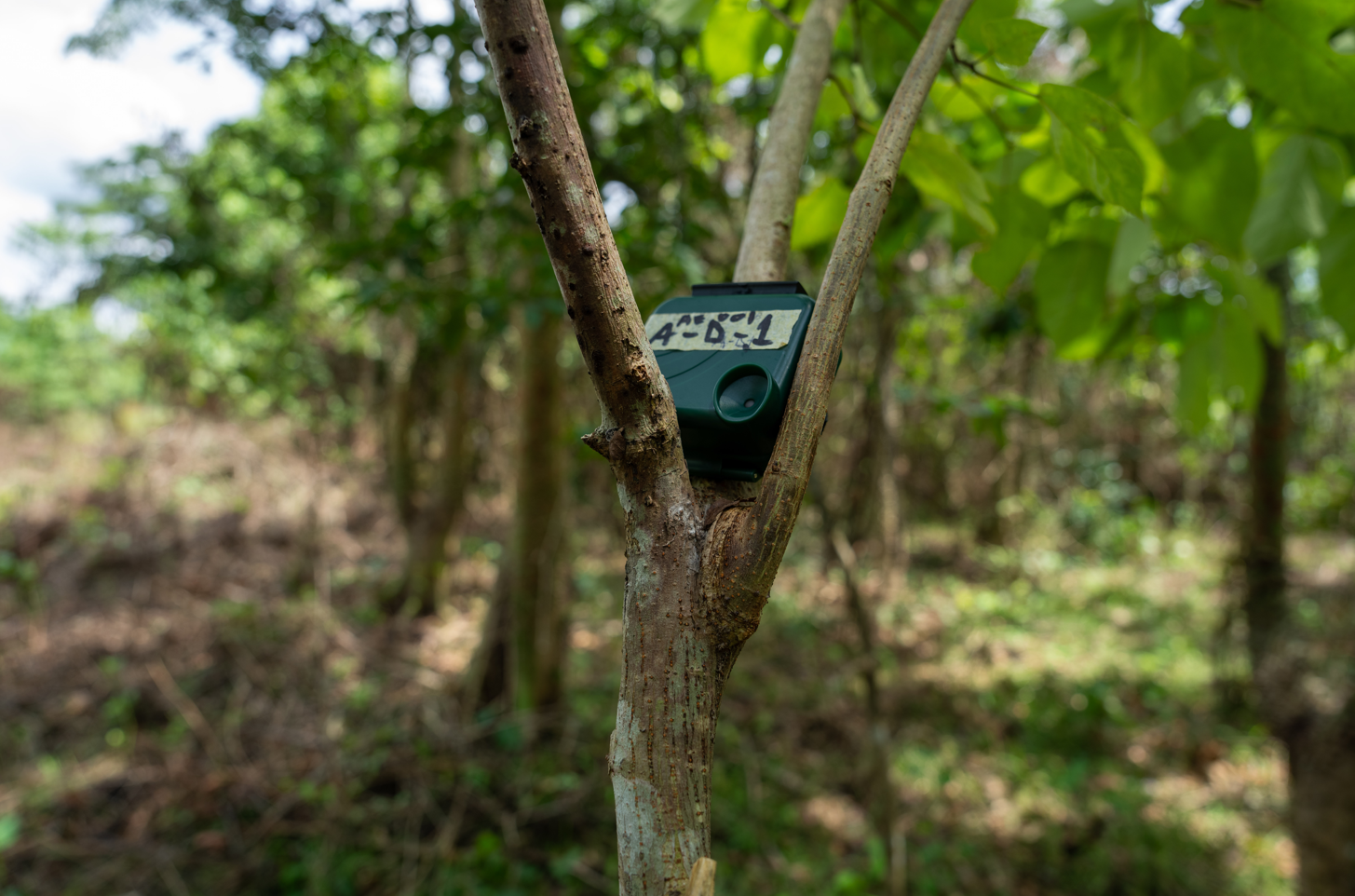
Another important component of our biodiversity monitoring work is the use of bioacoustics — these are automated sound recorders that record continuously for weeks or months at a time, capturing the soundscape of the forest. Research has shown that the quality, diversity and intensity of sounds being made naturally within an environment can tell you a lot about the status of biodiversity there. From birds to frogs and bats to insects, most components of the forest ecosystem make noises of some form – and these choruses can be recorded and analysed to create a meaningful indicator of ecosystem health. While bioacoustics does not always allow for precise species-level identification (especially in species-rich tropical forests), it provides something equally powerful: scale.
By analysing patterns in sound diversity and intensity, we can track changes in ecosystem condition – and by comparing the soundscapes of our project sites with those found in primary forests, we can effectively map how close we are getting to restoring the original ecosystem state. A more complex, vibrant soundscape often reflects higher biodiversity and greater ecological functioning – meaning we can “listen” to restoration happening in real time.
A New Frontier: eDNA
Recently, we have also begun piloting the use of environmental DNA for biodiversity monitoring in some of our sites. This technique takes advantage of the fact that all organisms shed genetic material into their surroundings over time — and this material can accumulate in water, soils or even in the air. By collecting environmental samples and analysing them using DNA barcoding techniques, we can detect species without ever seeing or hearing them.

While our work with eDNA has only been exploratory to date, it has already thrown up some of our most remarkable findings to date in tropical restoration landscapes. Through eDNA analysis of water collected from small ponds and streams across our project sites, we have discovered that two Critically Endangered species are inhabiting our project area in Ghana – the Home’s Hinge-backed Tortoise (Kinixys homeana) and Afia Birago's Puddle Frog (Phrynobatrachus afiabirago). The detection of these small, cryptic but highly threatened species was a huge surprise to the team, and highlights just how important it is that efforts are made to protect and restore the forests in the region in which we work. The tortoise has a fairly wide historical distribution within the Upper Guinean forest zone, but has declined dramatically due to habitat loss and hunting, whereas the frog was previously known from one tiny area in another part of Ghana’s high forest zone. Both species are dependent on native tropical forests for their survival, so both stand to benefit greatly as our forest restoration activities bear fruit.
Turning the tide for biodiversity in West Africa
Across much of West Africa, native forests have been degraded and depleted to the point that many forest species — such as the African forest elephant and the African forest buffalo — have disappeared entirely. Other species continue to cling to survival in remnant forests, but their populations are vulnerable. Hunting pressure also remains a significant threat to wildlife across the region, and while subsistence hunting is not inherently incompatible with wildlife conservation, the compounding effects of shrinking habitats and growing human populations place ever greater pressures on hunted populations. International trade adds another layer of pressure, with high market demand for wildlife products putting species like pangolins under severe threat, with trapping for export driving rapid declines in many areas.
Above: the Common Cusimanse is a small, social mongoose found in dense rainforest undergrowth where it lives in groups and forages cooperatively for insects, small vertebrates, and fruits. Although seldom seen by human observers, our passive monitoring has shown this species to be fairly common across our project areas in Ghana.
Amid this complex web of threats, one principle remains clear: wild animals need space. Large, contiguous areas of diverse native forest are fundamental to sustaining viable wildlife populations. Restoring these habitats increases carrying capacity, reconnects fragmented patches, and improves ecological resilience, supporting populations that can then withstand moderate hunting pressure and environmental fluctuations. Reforestation, when done well and at scale, can re-build the physical infrastructure that wider biodiversity depends on. The return of wildlife is often gradual and uneven, but every confirmed sighting, every new call captured on an acoustic recorder, every new DNA trace in a water sample will give us the confidence that restoration is working.
Ultimately, the success of large-scale reforestation in West Africa will not be measured solely in hectares planted, but in ecosystems restored — in forests that once again function as homes for thriving communities of life. For those of us working in restoration, there is nothing more motivating than that possibility. The forests are growing. And slowly, quietly, life is returning with them.


