
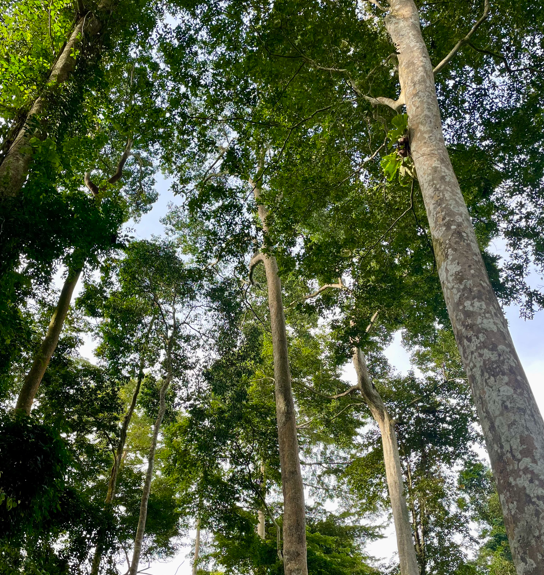
Ground truth: A forest scientist's journey measuring West Africa's forests
Dr Paly Titenwi, Rainforest Builder’s Carbon Monitoring Specialist, describes how her childhood fascination for trees led her to pursue a career in forest research and ultimately put science into practice with Rainforest Builder.
Dr Paly Titenwi's research has brought new advances in our understanding of the carbon dynamics of regenerating forests in West Africa, highlighting key environmental factors that influence rates of growth and carbon sequestration (see her latest paper here to find out more). With Rainforest Builder, her work focuses on collecting new high-integrity datasets from our project landscapes that will allow us to monitor changes in carbon and biodiversity with ever greater precision.
Growing up surrounded by the green hills and farming landscapes of Cameroon, I was always fascinated by forests. I enjoyed spending time in them, surrounded by their calm complexity and appreciating the quiet power they hold in regulating our environment. My love for trees grew, and in time I was fortunate to get the opportunity to study for a degree in Botany at the University of Bamenda. Studying the works of the UNFCCC and IPCC made me see trees not only as living organisms but also as essential climate allies and critical guardians of biodiversity. When I learned how little field data existed on forest carbon dynamics in West Africa, I knew I wanted to be part of the solution. That determination stayed with me and eventually I was able to pursue forest research as a career, and ultimately to study for a PhD in plant diversity and carbon storage at the University of Bamenda.
When I started out, I imagined I was heading towards a future centered around teaching and scholarly research. However, as my career developed, I felt a growing sense of the need to help protect these living systems that are so vital to our climate and community health. African forests face threats from deforestation and land use change, yet they remain one of our most powerful tools in combating climate change. This understanding began to influence my path beyond academia, steering me toward fields where I can contribute directly to forest protection and restoration.
Learning from the Forest
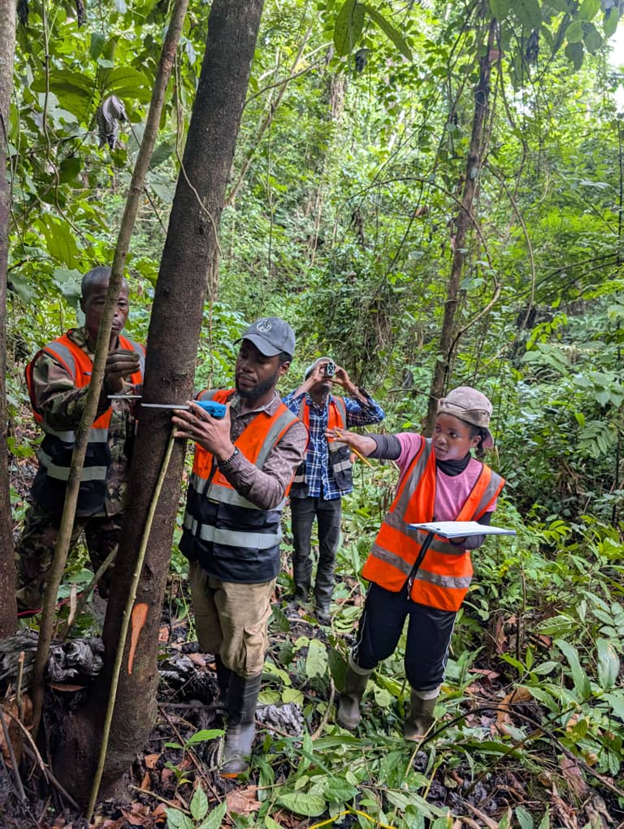
My research took me across some of the region’s most diverse and threatened landscapes, from Gola Rainforest to Outamba-Kilimi (Sierra Leone), Ziama (Guinea), Wonegizi, Sapo-Grebo-Krahn (Liberia), and Tai National Park (Ivory Coast). These places are among the few that still hold intact forests in West Africa, and reaching them was never easy. Our field expeditions involved day after long day navigating endless potholed muddy roads, followed by trekking for kilometers through flooded mining and logging trails to finally set up camp in the last remaining forest strongholds. The challenge of reaching these places was a vivid reminder that the most beautiful things are often the ones best hidden. Despite the difficulties of travel, it was always exciting to interact with people of diverse cultures, traditions, and lifestyles in these remote places. Being the only female of the main team, I often felt there was a pressure to prove my strength, but I used this as a motivation and did not relent. I spent months with my team establishing sample plots, painstakingly measuring the diameter and height of trees, and identifying species.
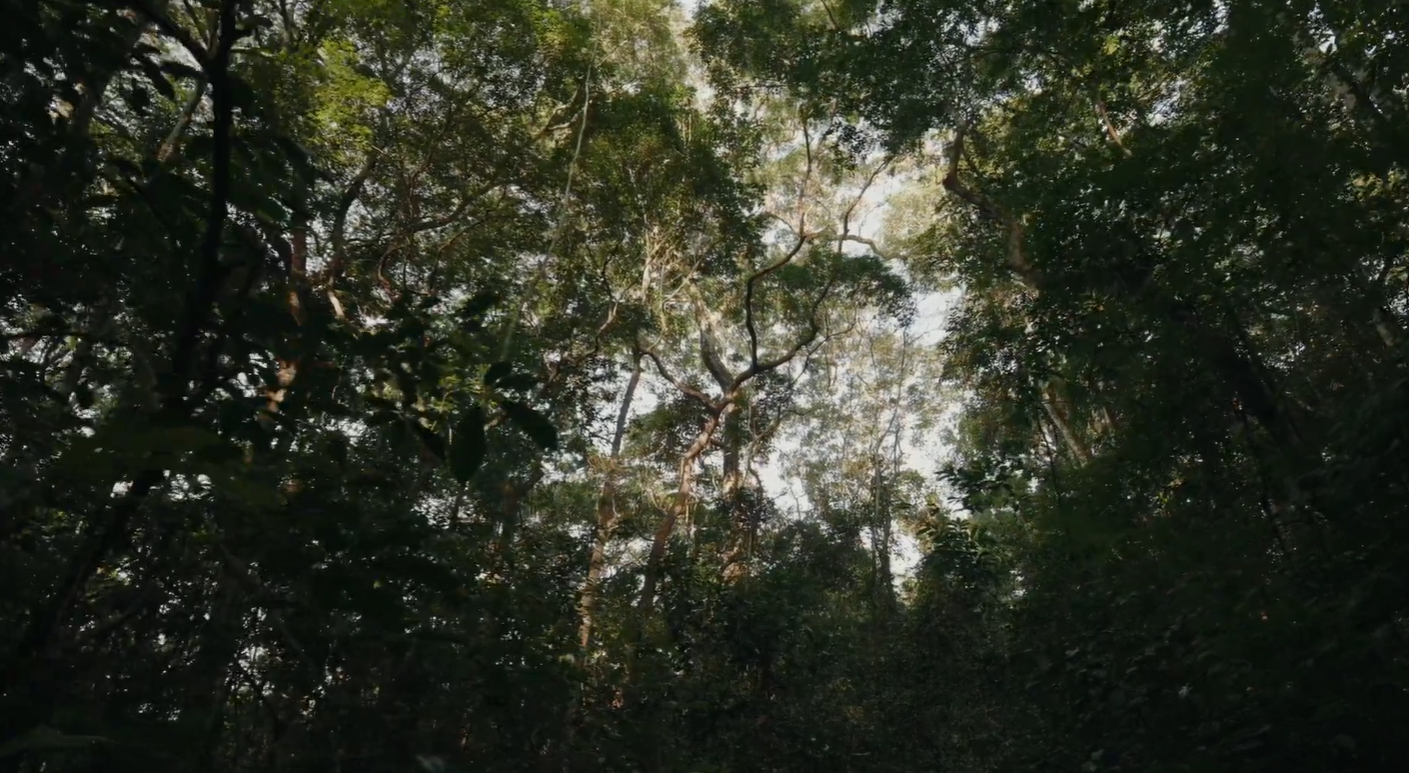
Those long days in the field taught me that good science depends on good data. In an age where satellites and drones offer instant forest images, it’s easy to forget the value of boots-on-the-groundwork. Yet to truly measure forest carbon, we must touch the trees, measure them with detail and precision, and know their names. Remote sensing offers us instant estimates, but it’s the field data that make those estimates reliable. The exact diameter, height, and wood mass density of each tree must be quantified to work out how much biomass it stores – and these must be measured perfectly on the ground before we can assess how much carbon any forest holds.
I also learned how easily small errors, a mis-recorded height, or a misspelled species name can distort carbon calculations. Precision, consistency, and patience became the foundations of my research philosophy.
When the Forest tests me
No Ph.D. is complete without its share of hurdles, and mine was no exception. Some moments are still vivid in my memory. After camping in one of Liberia’s plots, my group lost our pathway out, with no working GPS or village guard to help us. The feeling of being lost in the forest, with darkness fast approaching, can be terrifying. But one important role I learnt was always to remain calm, never to lay blame, but to seek possible ideas from each other. As we navigated through the forest in our best guess for the right direction, we happily heard the cries of hunters from the local community who had been organized to seek us by others from our team. There were many such challenges that reinforced a powerful lesson: success in fieldwork depends on planning, persistence and teamwork.
Perhaps my biggest personal challenge was balancing scientific ambition with logistical realities. Working across multiple countries meant navigating language barriers, customs, and varying field conditions from humid lowland rainforests to impenetrable degraded secondary forests. Yet each challenge strengthened my resolve and deepened my understanding of how important these forests are for the sustainability of our socio-ecological systems.
Those challenges also built resilience. They taught me the tremendous value and necessity of teamwork. Working alongside local people from the communities around our research forests taught me as much as any lecture ever could. Their knowledge of tree species and forest use deepened my understanding of how closely people and forests are intertwined. For conservation and restoration, I realized, is as much about people as it is about trees.
Putting Science into Practice: My Work at Rainforest Builder
Today, I’m proud to put the lessons I have learnt into practice as a Carbon Monitoring Specialist at Rainforest Builder. My role focuses on ensuring the accuracy and credibility of forest carbon data, from field measurements to plot validation and reporting. I help design monitoring protocols, train field teams, and make sure the data we collect feeds into reliable carbon models.
This work allows me to see how science translates into impact. High-quality data is essential to underpin trustworthy carbon credits, and those credits in turn support forest restoration, local employment, and sustainable livelihoods. It’s rewarding to know that the same principles I learned during my PhD of precision, transparency, and ecological understanding, now contribute directly to climate-positive outcomes.
At Rainforest Builder, I’ve found a community that values both technology and field expertise. Every dataset we generate strengthens confidence in our nature-based solutions, and demonstrates that restoration and development go hand in hand.
Looking Ahead: Forests, Carbon, and Hope for West Africa
Forests have shaped my academic path, my professional growth, and my sense of purpose. From long days in muddy forest plots to data analysis sessions that stretched late into the night, I’ve learned that science, when connected to real-world impact, is one of the most powerful tools for change. Working with Rainforest Builder gives me the chance to turn that belief into action, one forest, one plot, one dataset at a time. My personal goal is to continue bridging research and practice to help design carbon projects that are both scientifically sound and socially equitable. I also hope to mentor other young women scientists who want to work at the interface of ecology and development.
As I look toward the future, I see enormous potential for West Africa’s forests to contribute to climate resilience, sustainable development, and improved livelihoods. But that potential depends on strong science, transparent governance, and inclusive partnerships. The carbon market offers one pathway; when implemented responsibly, it can generate income for local communities, fund restoration, and promote biodiversity conservation.


